
Signal crayfish trapping at Burrator Reservoir in Devon
Signal crayfish (Pacifastacus leniusculus) are recognised as a widely established high impact Invasive Non-Native Species (INNS), in the UK, causing...


The Environmental Dimensional Partnership Ltd commissioned APEM to undertake the marine ecology elements of an EIA (Environmental Impact Assessment) for the proposed London Resort project. This involved designing and undertaking a programme of intertidal and subtidal benthic ecology surveys and fish surveys encompassing protected species, and invasive/non-native species, along the Thames Estuary near the Swanscombe Peninsula.
As the project is so large, it is classed as a Nationally Significant Infrastructure Project (NSIP). The project therefore required a Preliminary Environmental Information Report (PEIR), which also included a Marine Conservation Zone assessment and WFD (Water Framework Directive) assessment, all of which APEM provided.
The survey programme was designed to provide a greater understanding of the marine species and habitats surrounding the proposed development area including saltmarsh. The data gathered would inform an assessment of the potential impact of the proposed London Resort project on the marine environment.
APEM were employed as a specialist contractor to deliver the intertidal, subtidal benthic and fish surveys, and to coordinate saltmarsh surveys along with completion of the associated lab analysis, survey reports, ES chapters, WFD Assessment and MCZ Assessment.

The survey programme was designed to provide a greater understanding of the marine species and habitats surrounding the proposed development area including saltmarsh
The specification for each survey and report was determined at a start-up meeting to define the requirements for each deliverable. An initial desk-based review was conducted to determine the need and scope of each survey.
An intertidal mapping survey and quantitative coring survey was completed in the vicinity of White’s Jetty, Bell’s Wharf and the New Ferry Terminal. Phase I surveying was conducted to map intertidal habitats at a broad scale, groundtruthing habitat mapping derived from aerial imagery. The methods used were based on consideration of best practice guidance. Biotopes/habitats were assigned in the field (which was refined once core samples from the Phase II survey were analysed). For the Phase II survey, quantitative intertidal core samples were taken.
Key considerations of an EIA include potential effects of underwater noise and vibration effects (mainly from piling) on fish and marine mammals
Subtidal surveys were conducted to provide general site characterisation to inform the assessments and covered the requirement to sample for the tentacled lagoon worm (Alkmaria romijni) which can occur in the subtidal and intertidal zone and are classed as nationally scarce due to their vulnerability to habitat changes.
Grab surveys were used to characterise benthic habitats/species in the vicinity of the New Ferry Terminal and associated dredge pocket. Subtidal grab surveys involved deployment of a mini-Hamon grab sampler from a survey vessel.
All biological samples were processed according to APEM’s in-house Standard Operating Procedures (SOPs) and in full compliance with North-east Atlantic Marine Biological Analytical Quality Control (NMBAQC) scheme guidance. Taxa were identified to the lowest practicable taxonomic level, usually species, using appropriate taxonomic literature.
A desk-based review of Environment Agency water quality data from stations just upstream and downstream of the project site was conducted to inform the water quality assessment. In addition, a desk-based review of marine mammals was also completed.
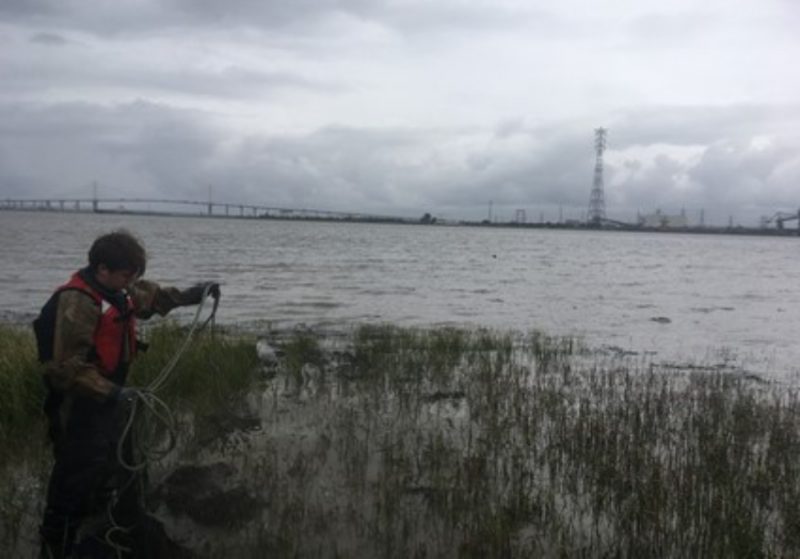
APEM undertook intertidal and subtidal benthic ecology surveys and coordinated saltmarsh surveys
An MCZ Assessment was completed to assess potential effects on the Swanscombe Estuary MCZ with focus on the tentacled lagoon worm.
A WFD Assessment was completed following the Clearing Waters for All guidance, using information gathered via desk-based review and the project-specific surveys. This utilised the SeDiChem tool which APEM had developed previously for the Environment Agency. SeDiChem determines increases in chemical concentrations in the water column following an activity such as dredging.
The PEIR Chapter and ES Chapters of the EIA were completed using information gathered from all field and desk-based surveys and the assessment was conducted based on CIEEM guidance.
We’re proud to support our clients with projects large and small, and our specialist teams work together to provide accurate, reliable results that our clients can trust. If you’re looking for advice about surveys or would like to find out more about our marine team, contact us here.
Get hand-picked content from our subject matter specialists. Sign up to receive relevant updates, resources, and ideas that help you and your organisation.
We're here to help. Whether you're looking for tailored insights, support with a project, or just want to explore how we can work together, contact our team today.
Signal crayfish (Pacifastacus leniusculus) are recognised as a widely established high impact Invasive Non-Native Species (INNS), in the UK, causing...

Through our network of specialist brands and strong presence in Australia and Europe, APEM Group brings decades of expertise to...

In 2020 the specialist team at APEM were commissioned by SSE Renewables to investigate the movement and behaviour of Atlantic...